REI — 霊 | Japanese Ambient Music for Deep Focus, Eerie Calm & Halloween Nights
Zen Shodo
1 views
REI — 霊 is the spirit. The character is read rei, and also tama, the old Japanese
word for the soul that was believed to live in people, in trees and stones, and even
in words: kotodama, the spirit of words. In its older form the character shows rain
at the top and a shrine maiden below, a prayer sent up to the sky. Japan has long
lived close to its spirits. In summer, during Obon, the souls of ancestors are
welcomed home with lanterns and sent off again with fire. Ghost stories, kaidan, were
told on hot nights to bring a chill, and on the kabuki stage a ghost appears to a
wavering flute and a low rolling drum, a sound so well known that it has its own
name: hyu-dorodoro.
In this painting the character is written in black ink, and smoke of ink curls up
from its strokes. A large ghost reaches out from the upper right, a small one drifts
by a tiny castle at the upper left, and a grinning pumpkin in a witch's hat peers out
of the smoke, as if the spirits of two worlds had met for one October night. In the
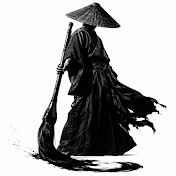
middle a figure in a straw hat stands calmly among them, holding a large brush.
Shodo — Japanese calligraphy — asks for a single moment of full attention. The brush
is dipped in ink, and there is only one attempt. Nothing can be fixed once the ink
meets the paper. The whole body gathers into one breath, and the character is written
on the hanshi without stopping. The music on this channel is made for the state of
mind that a single stroke demands.
This time the music is a little eerie. A breathy shakuhachi carries the melody with
wavering bends and slow, sighing slides, one phrase at a time, with silence between.
A koto adds a few dark notes in an old Japanese scale. The low strings of the bass
koto and a faint shimmer of the sho hang far behind, and now and then a deep taiko
rolls softly in the distance, like thunder on a misty night. Mysterious, but calm —
no sudden sounds, nothing to startle you.
This Japanese ambient music is made for the long hours: when you need to focus
deeply, read or write late into an autumn night, let the tension of the day go, or
simply enjoy a quiet, slightly haunted evening.
— Good for —
Deep work and long study sessions
Reading, writing, quiet thinking
Meditation and zazen practice
Halloween nights and ghost stories
— Genre —
Japanese Zen Music / Koto Music
Deep Focus Music / Study Music
Shakuhachi / Meditation Music
Dark Ambient / Halloween Ambience
Headphones bring out the far-off taiko
— About Zen Shodo —
One brush. One breath.
One stroke across white paper.
Japanese zen ambient for people
who need to concentrate.
Note: the 霊 in the video is not written in the correct
form or stroke order, sorry. Looking forward to the day
AI gets good enough to write it properly.
Subscribe → @zenshodo
© 2026 Zen Shodo. All rights reserved.
Unauthorized reuploading, duplication,
or distribution is strictly prohibited.
REI — 霊 | Japanese Ambient Music for Deep Focus, Eerie Calm & Halloween Nights
Zen Shodo
1 views
REI — 霊 is the spirit. The character is read rei, and also tama, the old Japanese
word for the soul that was believed to live in people, in trees and stones, and even
in words: kotodama, the spirit of words. In its older form the character shows rain
at the top and a shrine maiden below, a prayer sent up to the sky. Japan has long
lived close to its spirits. In summer, during Obon, the souls of ancestors are
welcomed home with lanterns and sent off again with fire. Ghost stories, kaidan, were
told on hot nights to bring a chill, and on the kabuki stage a ghost appears to a
wavering flute and a low rolling drum, a sound so well known that it has its own
name: hyu-dorodoro.
In this painting the character is written in black ink, and smoke of ink curls up
from its strokes. A large ghost reaches out from the upper right, a small one drifts
by a tiny castle at the upper left, and a grinning pumpkin in a witch's hat peers out
of the smoke, as if the spirits of two worlds had met for one October night. In the
middle a figure in a straw hat stands calmly among them, holding a large brush.
Shodo — Japanese calligraphy — asks for a single moment of full attention. The brush
is dipped in ink, and there is only one attempt. Nothing can be fixed once the ink
meets the paper. The whole body gathers into one breath, and the character is written
on the hanshi without stopping. The music on this channel is made for the state of
mind that a single stroke demands.
This time the music is a little eerie. A breathy shakuhachi carries the melody with
wavering bends and slow, sighing slides, one phrase at a time, with silence between.
A koto adds a few dark notes in an old Japanese scale. The low strings of the bass
koto and a faint shimmer of the sho hang far behind, and now and then a deep taiko
rolls softly in the distance, like thunder on a misty night. Mysterious, but calm —
no sudden sounds, nothing to startle you.
This Japanese ambient music is made for the long hours: when you need to focus
deeply, read or write late into an autumn night, let the tension of the day go, or
simply enjoy a quiet, slightly haunted evening.
— Good for —
Deep work and long study sessions
Reading, writing, quiet thinking
Meditation and zazen practice
Halloween nights and ghost stories
— Genre —
Japanese Zen Music / Koto Music
Deep Focus Music / Study Music
Shakuhachi / Meditation Music
Dark Ambient / Halloween Ambience
Headphones bring out the far-off taiko
— About Zen Shodo —
One brush. One breath.
One stroke across white paper.
Japanese zen ambient for people
who need to concentrate.
Note: the 霊 in the video is not written in the correct
form or stroke order, sorry. Looking forward to the day
AI gets good enough to write it properly.
Subscribe → @zenshodo
© 2026 Zen Shodo. All rights reserved.
Unauthorized reuploading, duplication,
or distribution is strictly prohibited.